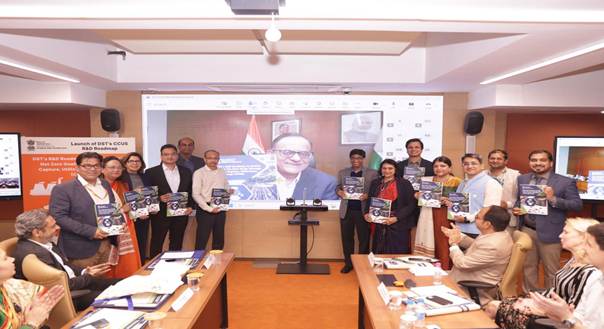
New Delhi, December 4, 2025 : India has taken a major step toward meeting its long-term climate commitments with the launch of the country’s first R&D Roadmap to Enable Net Zero Targets through Carbon Capture, Utilization and Storage (CCUS). The roadmap, prepared by the Department of Science and Technology (DST), was officially unveiled on 2 December 2025 by Prof. Ajay Kumar Sood, Principal Scientific Adviser (PSA) to the Government of India.
Prof. Sood described the roadmap as a strategic guide for coordinated national action on climate solutions, noting that as India advances toward its Net Zero vision, the CCUS Roadmap will foster collaboration, drive investments, and accelerate technology deployment. He emphasised that the roadmap will play a critical role in reducing the nation’s carbon footprint and strengthen India’s position as a responsible global partner—fully aligned with Viksit Bharat@2047.
DST’s Leadership in CCUS Innovation
Prof. Abhay Karandikar, Secretary, DST, highlighted the Department’s pioneering role in steering CCUS R&D in India. He noted that the roadmap balances two key priorities:
- Advancing current CCUS technologies toward commercial readiness
- Supporting breakthrough science to develop next-generation solutions
He also underscored the need for supportive frameworks, including skilled human resources, regulatory standards, and early shared infrastructure. Prof. Karandikar reiterated DST’s readiness to lead implementation through major initiatives such as the ₹1 Lakh Crore Research, Development & Innovation (RDI) Scheme, which will strengthen private-sector-led innovation in industrial decarbonisation.
CCUS: A Core Pillar of India’s Net Zero Strategy
As India pursues the goal of achieving Net Zero emissions by 2070, CCUS has emerged as a crucial technology for decarbonising hard-to-abate sectors such as:
- Power
- Cement
- Steel
DST has established CCUS test beds in real industrial environments through innovative public–private partnerships. These test beds, backed by nearly seven years of DST-led CCUS R&D, are enabling the development, validation, and scaling of advanced carbon capture technologies.
Strategic Vision of the CCUS Roadmap
The roadmap draws on the expertise of a High-Level Task Force (HLTF) and outlines:
- Thematic priorities for targeted CCUS research
- Funding pathways for accelerated development
- The need for regulatory frameworks, safety standards, and human capital development
- Support for next-generation CCUS breakthroughs
- Guidance for early infrastructure planning to reduce deployment barriers
Expert Insights and Community Participation
Dr. Ashish Lele, Chair of the HLTF and Director of CSIR–NCL, Pune, emphasised the pivotal role of DST in shaping India’s CCUS R&D landscape.
Dr. Anita Gupta (Head, CEST, DST) and Dr. Neelima Alam (Associate Head, CEST, DST) provided detailed insights into national and multilateral CCUS initiatives supported by DST, highlighting the establishment of India’s first three National Centers of Excellence in CCUS.
The launch event witnessed strong participation from:
- Academia and research institutions
- Government representatives and policymakers
- International partners and embassy delegates
- Industry leaders from energy, steel, cement, manufacturing, and technology sectors
- Multilateral organisations and national laboratories
A Milestone Toward a Sustainable Future
The R&D Roadmap represents a major milestone for India’s climate strategy. By defining actionable pathways for innovation, regulation, and deployment, it positions CCUS as a central pillar in achieving long-term decarbonisation goals, supporting sustainable development, and bolstering India’s leadership in global climate action.