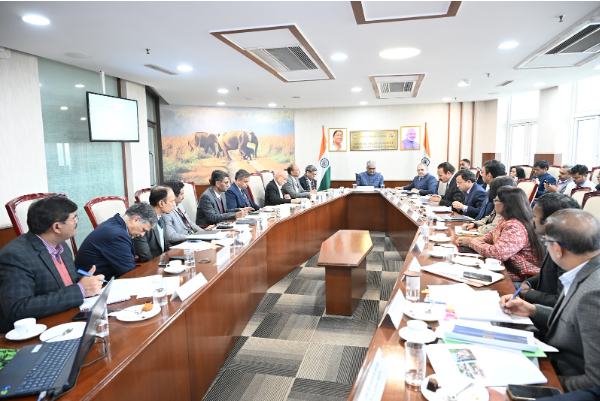
New Delhi | 6 January 2026 : The Union Minister for Environment, Forest and Climate Change, Bhupender Yadav, today chaired a high-level review meeting to assess the action plans submitted by the State Governments of Rajasthan and Punjab for addressing air pollution in the Delhi-NCR region. This was the fifth meeting in the ongoing series of Ministerial-level reviews being conducted on prescribed parameters.
Expressing concern over persistently poor air quality in Delhi-NCR throughout the year, the Minister announced that monthly reviews of State action plans will commence from January 2026. He directed that sector-wise targeted action plans be prepared with clearly fixed accountability on concerned departments to ensure effective execution and visible improvement in the next pollution season. He also assured that implementation challenges would be addressed through regular inter-State coordination at the highest level.
While reviewing Rajasthan’s plan, Shri Yadav highlighted critical gaps in public transport infrastructure in Alwar, Bhiwadi, Neemrana, and Bharatpur. He directed priority procurement of electric buses, rapid expansion of charging infrastructure in urban areas and along highways, and immediate action on unplanned truck parking along National Highways in Bhiwadi and Neemrana to reduce congestion and emissions.
The Minister also called for city-specific road redevelopment and traffic decongestion plans, accelerated liquidation of legacy municipal waste, and immediate deployment of Mechanical Road Sweeping Machines (MRSMs). He noted that over 600 locations have been identified in Alwar and Bhiwadi for roadside greening with community participation. Strict action, including closure notices, was directed against non-compliant industrial units that have failed to install Online Continuous Emission Monitoring Systems (OCEMS).
Reviewing Punjab’s action plan, Shri Yadav emphasised effective crop residue management and directed that all CRM machines be kept in working condition, supported by SOP-based certification. He encouraged innovative solutions to curb stubble burning, including pelletisation plants, utilisation of crop residue in thermal power plants and brick kilns, and installation of Compressed Bio-Gas (CBG) plants. Drone-based surveillance was also recommended to deter crop residue burning.
The meeting was attended by senior officials from the Commission for Air Quality Management (CAQM), Central Pollution Control Board (CPCB), concerned Union Ministries, State Pollution Control Boards, and representatives of the Rajasthan and Punjab Governments.
The review reaffirmed the Government’s commitment to coordinated, accountable, and result-oriented action to improve air quality and safeguard public health in the Delhi-NCR region.