
Labour Codes Transform Welfare Framework for India’s Construction Workforce
The Government of India has undertaken a historic overhaul of labour governance through the implementation of the four comprehensive Labour Codes—The Code on Wages (2019), The Industrial Relations Code (2020), The Code on Social Security (2020), and The Occupational Safety, Health and Working Conditions Code (2020). These reforms significantly strengthen the welfare architecture for Building and Other Construction Workers (BOCW), a sector known for its large, mobile and vulnerable workforce.
The new framework ensures an integrated approach to wage protection, workplace safety, social security, and formal documentation. As a result, construction workers across India will experience more consistent working standards, clearer rights, and enhanced access to welfare benefits.
Wage Protection & Income Security
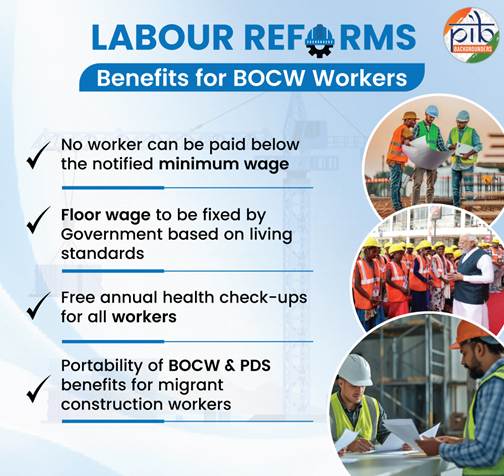
The Labour Codes introduce universal minimum wages applicable to all employees, ensuring no worker is paid below the legally notified wage. A national floor wage, based on living standards, will guide the minimum wage rates fixed by the Centre and States. Timely payment of wages is now mandatory, with strict timelines prescribed for daily, weekly, fortnightly and monthly wage earners, as well as for payments upon termination. Overtime work must be compensated at twice the regular wage rate. The limitation period for wage-related claims has been expanded to three years, offering workers improved access to justice.
Health, Safety & Welfare Measures
Stronger safety norms under the OSH Code extend protections to all establishments, ensuring cleaner worksites, safe drinking water, toilets, rest rooms and canteens where applicable. Accidents during commuting are now included under employee compensation. Every employee is entitled to free annual health check-ups, and welfare schemes offer life and disability cover, health and maternity benefits and old-age protection. These measures significantly improve long-term well-being and dignity at work.
Advancing Worker Rights & Formalisation
The reforms mandate issuance of appointment letters to all employees, enhancing transparency in terms of employment and social security entitlements. The definition of “family” for female employees has been expanded to include in-laws, ensuring broader coverage. Migrant workers benefit from widened definitions and portability of welfare entitlements, including access to the BOCW Cess Fund and PDS rations across States.
Equality & Gender Justice
The Labour Codes reinforce workplace fairness by prohibiting gender-based discrimination in recruitment, wages and working conditions for the same or similar nature of work. This ensures a more equitable and respectful work environment for women in the construction sector.
A Stronger, Safer Future for BOCW Workers
By consolidating wage regulation, safety norms, social security and formalisation into a streamlined system, the Labour Codes represent a major step forward for India’s construction workforce. These reforms provide stronger legal accountability, universal coverage and an enhanced welfare framework that collectively support safer worksites and empowered workers.
The transformation marks a significant milestone in India’s labour reform journey—placing dignity, protection and inclusivity at the heart of the nation’s development.