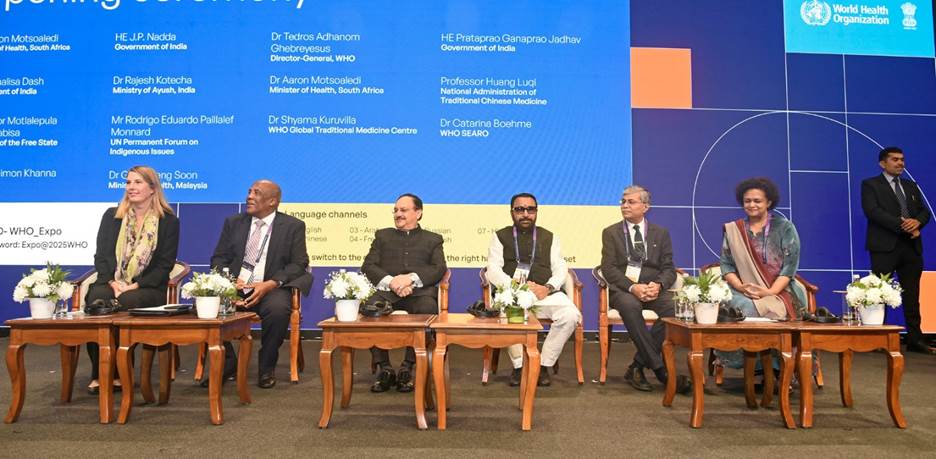
New Delhi, December 18, 2025: The Second WHO Global Summit on Traditional Medicine commenced today at Bharat Mandapam, New Delhi, with the inauguration led by Union Minister of Health and Family Welfare Shri JP Nadda, in the presence of Union Minister Shri Prataprao Jadhav. The three-day global summit, being held from 17 to 19 December 2025, is jointly organized by the World Health Organization (WHO) and the Ministry of Ayush, Government of India, under the theme “Restoring Balance: The Science and Practice of Health and Well-Being.” Prime Minister Shri Narendra Modi is expected to grace the closing ceremony on December 19.
Dr. Tedros Adhanom Ghebreyesus, Director-General of WHO, in a special video message, applauded India’s leadership and partnership in advancing traditional medicine globally. He highlighted the adoption of the WHO Global Traditional Medicine Strategy 2025–2034, which emphasizes strengthening scientific evidence, ensuring safety and quality through regulation, integrating traditional medicine into national health systems, and promoting sustainability and community well-being. He also underlined the significance of the WHO Global Centre for Traditional Medicine established in India.
Addressing the inaugural session, Union Minister Shri Prataprao Jadhav stated that India’s collaboration with WHO reflects a shared vision of mainstreaming traditional medicine through science, standards and evidence. He highlighted key milestones such as the inclusion of Ayurveda, Siddha and Unani in ICD-11 Module 2, ongoing work on the International Classification of Health Interventions, and the upcoming WHO Global Traditional Medicine Centre at Jamnagar. Shri Jadhav also outlined India’s expanding global engagement through scholarships, international MoUs, collaborative research and digital initiatives like the Ayush Grid.
Secretary, Ministry of Ayush, Vaidya Rajesh Kotecha, reaffirmed India’s global commitment to science-based, sustainable and equitable traditional medicine. He noted that the Summit builds upon the outcomes of the first Global Summit and the Gujarat Declaration, with a focus on strengthening regulation, safeguarding biodiversity and traditional knowledge, and leveraging frontier technologies in alignment with the WHO Global Traditional Medicine Strategy.
A key highlight of the inaugural day was the parallel session on “Ashwagandha: From Traditional Wisdom to Global Impact,” where global experts discussed clinical evidence, safety, standards and regulatory perspectives related to Ashwagandha. The session emphasized the importance of rigorous research, harmonized global standards and responsible integration into modern healthcare.
The Summit also began a series of plenary sessions addressing balance in global health systems, equity in traditional knowledge, biodiversity conservation and governance frameworks for Traditional, Complementary and Integrative Medicine (TCIM). Discussions underscored the need for inclusive, evidence-based and justice-driven approaches to position traditional medicine as a vital contributor to global health and planetary well-being.
The deliberations over the coming days are expected to shape future technical cooperation and policy directions for integrating traditional medicine into sustainable global health systems.