Delhi ( 17 December 2025 ) : The year 2025 marked a landmark phase for India’s space programme, with the Department of Space and ISRO achieving major technological, scientific and international milestones aligned with Space Vision 2047.
A key highlight was the SPADEX Mission, which successfully demonstrated indigenous space docking, undocking, power transfer and circumnavigation technologies—critical capabilities for future human spaceflight and space station missions. The mission achieved two successful docking events in orbit in January and April 2025.
ISRO made a significant leap in space biology through CROPS-1, where seed germination and early plant growth were successfully demonstrated in microgravity onboard POEM-4. The POEM-4 platform itself completed 1,000 orbits, hosting a record 24 payloads including AI-in-orbit experiments, robotics and green propulsion tests.
India strengthened solar and Earth observation science with the release of Aditya-L1 scientific data and the launch of the ISRO-NASA NISAR satellite, a milestone in Indo-US collaboration enabling all-weather, day-night global Earth monitoring.
ISRO marked its 100th launch from Sriharikota with GSLV-F15 and achieved its 101st launch attempt with PSLV-C61. The Union Cabinet approved the Third Launch Pad at SDSC SHAR, while foundation stones were laid for new launch infrastructure at Kulasekarapattinam (SSLV Launch Complex).
In human spaceflight, India celebrated a historic achievement as Gaganyatri Shubhanshu Shukla became the first Indian to visit the International Space Station under the Axiom-04 mission, completing 18 days of scientific experiments in microgravity. ISRO also successfully conducted the first Integrated Air Drop Test for the Gaganyaan Crew Module.
Technological self-reliance was reinforced with the development of India’s first Make-in-India 32-bit space-qualified microprocessors, successful semi-cryogenic engine hot tests, 1000-hour life test of plasma thrusters, and in-space restart of the cryogenic stage on LVM3-M5, which also launched the CMS-03 communication satellite, the heaviest ever from Indian soil.
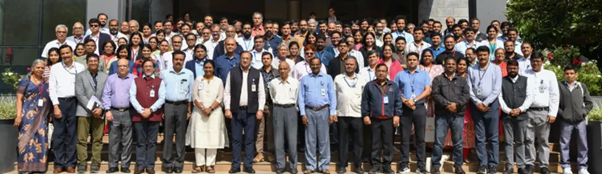
ISRO expanded academia-industry collaboration through Centres of Excellence, Academia Connect workshops, and STC Confluence 2025, while youth outreach was strengthened via the NE-SPARKS programme. India hosted major global events including GLEX 2025 and showcased achievements at IAC 2025, Sydney.
In disaster management, ISRO assumed the lead role of the International Charter on Space and Major Disasters, and satellite data was used to forecast national wheat production, supporting evidence-based governance.
Scientific excellence was further highlighted by the discovery of a new exoplanet by PRL-ISRO and the signing of a MoU on Space Medicine, strengthening India’s preparedness for long-duration human missions.
Overall, 2025 reaffirmed India’s position as a leading global space power, combining innovation, self-reliance, international cooperation and societal impact, while laying strong foundations for the next phase of space exploration beyond 2047.